This Is the Way: Mandalorian and the Strengths of Found Family
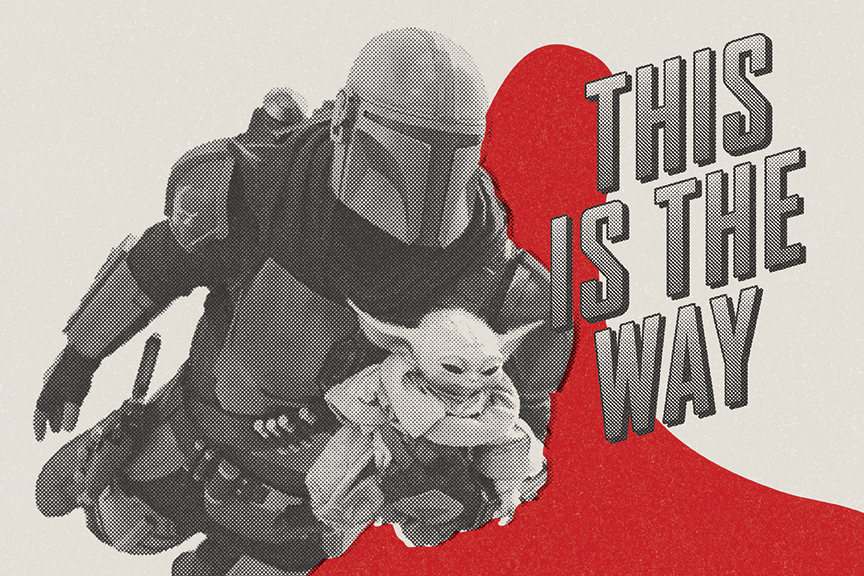
When Pedro Pascal first cradled the doe-eyed, tiny alien in his arms, Disney executives likely knew they struck gold. The dynamic between the lone bounty hunter and his new foundling makes for fun, bingeworthy television, but can The Mandalorian also serve as a blueprint for how young people thrive in chosen families?
For Professor Kendall Cotton Bronk, watching Pascal’s portrayal of stoic bounty hunter Din Djarin through the lens of developmental psychology provided an extra dimension for understanding youth development. While Grogu may actually be in his 50s (as fans know), the relationship between Din and “the Child” serves as a fascinating case study of how children thrive when raised by someone fulfilling the role, in all ways but biologically, of their parent.
The Family You Choose
At the heart of a series treating its fans to laser duels and fantastical beasts is a psychological thesis about what truly makes a family beyond blood relations.
“What really matters isn’t so much the genetic connection,” Bronk notes, “but the love, the support, the care that is demonstrated in a family. That can happen in either a biological family or in a chosen family. One way in which I think the bond between Grogu and Din is so strong is that it is chosen”
The tragically orphaned Grogu plays out a well-studied psychological reality. Biological families may provide foundational lessons about relationships and the world during crucial early development, but when those networks fail, young people naturally seek connection elsewhere. Teachers who see their potential, coaches who believe in them, friends who accept them, and even bounty hunters who risk everything to keep them safe. With no connection to his kin, Grogu reaches toward Din with tiny, desperate arms. On the other side, the Mandalorian who never expected to need anyone again, reciprocates and sets himself on a path of growth, realizing that protecting someone else gives his life an unexpected meaning.
“But We Don’t Look the Same”
The most overlooked psychological challenge facing Grogu, and real-world young people part of non-biological families, is cultural identity development. What happens when your heritage doesn’t match the family raising you?
In transracial adoption, foster care, and chosen families, this special tension surfaces when it comes time for identity development. “The most important thing to keep in mind,” Bronk speaks to mismatched heritages, “is that it doesn’t have to be one or the other. In optimal development, we find that children find ways of holding on to both of their identities.”
In early childhood, kids notice surface-level differences on a purely factual level. Skin colors are different, spoken languages are different. During adolescence, teens start asking deeper questions. “Who am I, really?” “Who do I want to become?” This integration process of synthesizing multiple cultural identities into one cohesive sense of self is a profound, and often painful, one.
Grogu faces this exact tension during what could be described as his adolescent years. The time when he seeks to learn more about his inherent powers in a way that the Mandalorian background of his caretaker cannot help uncover. The series and positive youth development both posit that the goal isn’t choosing one identity over the other, it’s finding a way to be authentically both.
I Am Your Father Figure
Ideally, a young person thrives with a diverse web of supportive relationships that positively influence different areas of their life. When studying the two most crucial roles, often seen as potentially overlapping, Bronk points out a clear line between them.
“There is a distinct difference between a mentor and a father figure,” explains Bronk. “A mentor really focuses on helping us develop skills in a particular area. They might help us grow in our professional development, maybe a sport, or some other activity that matters to us.” Grogu’s mentor role is clearly filled by Luke Skywalker, the Jedi master who offers him professional development in honing the dormant ability known to pop culture fans worldwide: The Force.
While mentors focus on building skills for the future to prepare young people for what they might become, however, they don’t necessarily play the role of a parent. “Father figures are different,” says Bronk. “They’re often a source of love and care and compassion and warmth.” Din does not have the capability to nurture Grogu’s abilities with the Force, but he is certainly his source of comfort, his safety blanket.
To Bronk’s fascination, The Mandalorian interestingly explores a youth development hypothesis tested decades ago: When presented with a choice between the two roles—which one wins?
The Harlow Effect
As a fan, Bronk held her breath in suspense watching Grogu having to choose between staying with his mentor, Luke, or returning to his father figure, Din. As a psychologist, she may have already known the answer.
In the 1950s, psychologist Harry Harlow tested a theory posing that babies loved their mothers primarily for food and survival. Researchers created two “mommy” substitutes: one a wire structure that dispensed food (meeting survival needs), and the other covered in a soft terrycloth purely offering warmth and comfort.
“The question was: where would the monkey choose to spend most of its time?” Bronk details the study. “The monkey chose to spend almost all of its time on the really soft, cozy, loving monkey-like structure and would only run over to the other one to grab food and then come back.”
The lesson helped redefine attachment theory: Young people need both—their survival needs met and emotional safety. But when forced to choose? They’ll typically select the latter. “I think that there are some parallels there [to Grogu and Din],” says Bronk, recalling how Grogu opts not for a life of destiny fulfillment alongside mentor Luke Skywalker, but for the comforting warmth of acceptance in his attachment to Din Djarin. Even if that warmth is from explosions during the hectic getaway schemes of a bounty hunter.
The Mandalorian Code: A Surprisingly Good Parenting Manual?
With Grogu having made his choice to stick with his father figure for better or worse, we watched the tiny creature become formally inducted into the brutish Mandalorian lifestyle. On the surface, it’s one fraught with danger, instability, and chaos, but does this mean Grogu’s development is doomed?
“In at least one really important way, The Mandalorian code seems to be well-aligned with positive youth development practices,” Bronk shares with surprise. “That has to do with the issue of contribution.”
To fully map out Grogu’s development under the Mandalorian Code, Bronk points to a widely used scientific model: The 5Cs of Positive Youth Development. “Young people are said to be thriving when they are competent, confident, connected, demonstrating character, and when they are caring. The outgrowth of all of those practices is often contribution, this desire to give back to the broader world in some personally meaningful way. That seems to be what the Mandalorian code is all about.”
Even though Din Djarin’s bounty-hunting ways may not paint him as a traditional moral exemplar, his commitment to the code helps him build a sturdy foundation for Grogu’s development in this intersection of contribution. If Positive Youth Development researchers and Mandalorians share any common ground, it is in that truth: for foundlings and children alike, a life well-lived is one dedicated to helping others.
To learn more about how young people cultivate purpose, character, and thriving identities, explore the current research coming from the CGU Adolescent Moral Development Lab.