What the Flex MBA Changed for May Saechao-Matsui
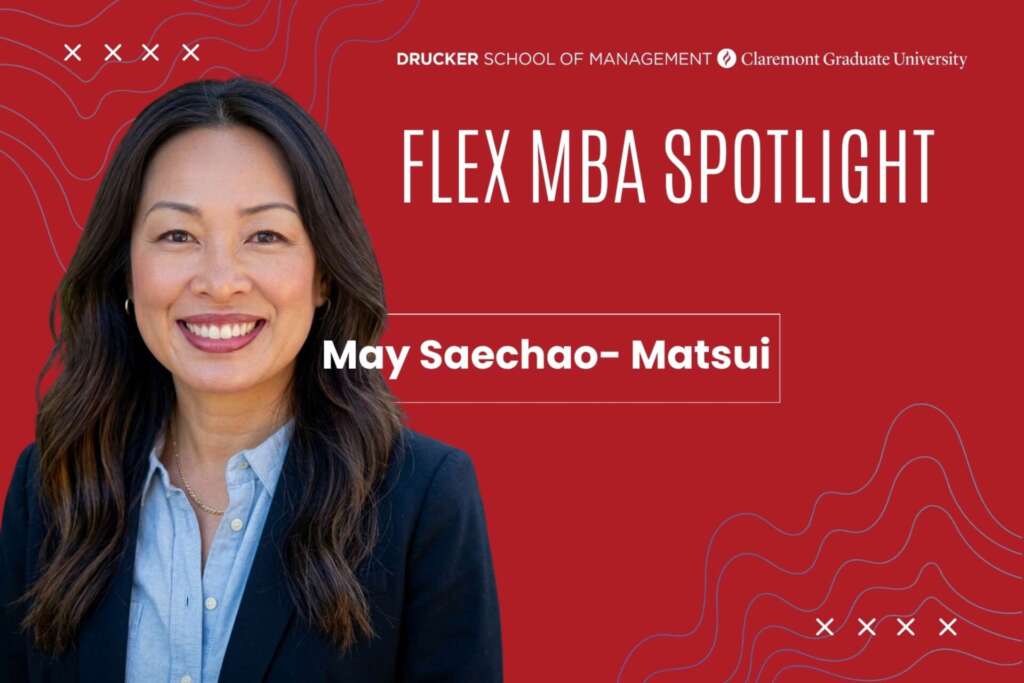
May Saechao-Matsui, Director of Loan Administration at Stanford Federal Credit Union and a Drucker Flex MBA candidate, on how one Drucker discipline (systematic abandonment) reshaped what she stops doing at work and what her team can do next.
Twenty years into her career and six years into financial-services management, May Saechao-Matsui came to the question that a manager faces after enough time running a team: how do you decide what your team should stop doing?
As Director of Loan Administration at Stanford Federal Credit Union, she runs a portfolio operation in which a manager can always add more meetings, reports, compliance checks, and dashboards, each of which can be defended on its own terms. What accumulates over time is a full calendar and a diluted purpose. She came to the Peter F. Drucker and Masatoshi Ito Graduate School of Management’s Flex MBA looking for a discipline built around the opposite question.
“I chose the Drucker MBA program because its people-centered philosophy aligns with my belief that human connection remains essential, especially in the post-COVID environment,” she says.
She had thought about graduate business school for years. The Flex MBA gave her a program that took the human side of management seriously, and a format she could complete alongside a full workload and four children at home.
How Does the Drucker Flex MBA Change the Way a Working Manager Leads?
The Principles of Drucker course is where she encountered the idea she now credits with reshaping how she runs her team: systematic abandonment. The principle, as Peter Drucker articulated it, is a question a manager should ask of every recurring activity. If we were not already doing this, would we start doing it today? If the answer is no, the activity is a candidate for stopping.
“Drucker’s guidance to discontinue activities we would not start today helped me recognize how many legacy processes in financial services no longer create value,” May says.
In her role, that meant stopping a manual report her team had been producing regularly that went unread by the people supposed to act on it. In its place, her team built a real-time dashboard the same audience actually opens.
“I now evaluate every initiative based on whether it advances our organizational purpose, rather than simply adding more tasks,” she says. “I focus on creating conditions for my team to perform at their best and use organized abandonment to eliminate low-value activities.”
The idea sits at the center of Drucker’s thinking about The Effective Executive. In his view, time was the executive’s scarcest resource, and what freed a team to do meaningful work was the manager’s willingness to decide, out loud, what the organization would no longer do. Mission clarity and knowledge-worker productivity followed from that discipline.
What Does “Never Too Late” Look Like?
May came to the Flex MBA on her own timeline. She was born in a refugee camp in Thailand and came to the United States at two years old. She was raised in Lodi. She spent much of her 30s raising her four children, then returned to full-time work in financial services. Now, in her late 40s, she is a Flex MBA candidate.
“I spent much of my 30s focused on raising my four children,” she says. “Approaching 50, I believe it’s never too late to pursue new learning and growth.”
The Flex MBA is designed for managers already in the middle of their careers, often in the middle of their lives. May uses it that way, testing ideas from her coursework on the work in front of her and bringing what she learns back to class. She has plans past the degree. She is exploring a professional network group for Drucker MBA students in financial services. Longer-term, she is aiming at senior leadership in credit unions, ultimately a COO or CEO seat.
Credit unions are, in one important respect, a Drucker-shaped kind of institution: cooperative, member-owned, existing to serve their members rather than maximize returns. The mission she is already trying to advance is one Drucker would have recognized on sight. She has said the same discipline has helped her at home. “Applying this same mindset at home has also brought clarity and calm,” she says.
About the Flex MBA at the Drucker School
The Flex MBA at the Peter F. Drucker and Masatoshi Ito Graduate School of Management is designed for working professionals seeking a graduate management education they can complete alongside their careers. Grounded in Peter Drucker’s view of management as a human discipline, the program equips practitioners to lead with mission clarity and disciplined decision-making.
Explore the Flex MBA program or request information
May Saechao-Matsui is a Flex MBA candidate at the Peter F. Drucker and Masatoshi Ito Graduate School of Management at Claremont Graduate University, expected to graduate in Winter 2027. She serves as Director of Loan Administration at Stanford Federal Credit Union.