Leadership with Integrity: What the Drucker School Taught Me About Management as a Whole

A Drucker School alumnus on why integrity means wholeness, and how that idea shaped the way he teaches management in Japan.
By Katsutoshi Fujita
CEO, Manage For Good Inc. · MBA 2004, Drucker School of Management
The Essence of Leadership
I graduated from the Peter F. Drucker and Masatoshi Ito School of Management at Claremont Graduate University in 2004. The two years I spent there were irreplaceable, and I learned not just business and management, but the deep essence of leadership. Leadership, more than a set of skills or knowledge, is a question of “who you are” and “how you live.” This is where Integrity—a management principle that Professor Peter Drucker valued above all else—comes into play. In this article, I would like to explore this connection, and how the root meaning of the word, “wholeness,” has shaped the way I teach management in Japan.
Leadership is fundamentally about our humanity, but it can also determine our actions and results. Leadership is essential whether you are leading an organization as a manager, launching a venture as an entrepreneur, engaging in community activities, or even within your own family. Leadership isn’t defined by rank or title. Being in top management doesn’t automatically mean you have leadership; in fact, it’s no exaggeration to say that even some CEOs lack it.
So, where does the legitimacy of leadership come from? It doesn’t come from a title, position, or charisma. Rather, it comes through a person’s influence—the kind that makes others trust and want to follow them—and the relationship of trust that results. People don’t choose to follow someone from the heart just because that person holds a high rank or has power. They follow because there is “something” about that person that makes them feel, “I want to commit my life to following them and reaching our goals together.” My mentor, Professor Jean Lipman-Blumen, who taught us leadership at the Drucker School, once said: “The role of a leader is to help those they work with find the ‘meaning of life’.” I understand the weight of those words much more deeply now than I did back then. The essence of leadership is helping others realize that “this action, this work, is worth doing in the context of my life.”
Integrity and Leadership
True leaders raise our sights. They help us look up from our daily “life” and “tasks” and focus instead on “significance,” “meaning,” and “purpose.” Professor Drucker defined leadership as follows:
“Leadership is lifting a person’s vision to higher sights, the raising of a person’s performance to a higher standard, and the building of a personality beyond its normal limitations.” (Peter F. Drucker, The Practice of Management)
Furthermore, he captured the core of leadership with these words:
“The final requirement of effective leadership is to earn trust. Otherwise, there won’t be any followers—and the only definition of a leader is someone who has followers. To trust a leader, it is not necessary to like him. Nor is it necessary to agree with him. Trust is the conviction that the leader means what he says. It is a belief in integrity. A leader’s action and a leader’s professed belief must be congruent, or at least compatible. Effective leadership—and again this is very old wisdom—is not based on being clever; it is based primarily on being consistent.” (Peter F. Drucker with Joseph A. Maciariello, Management: Revised Edition)
Drucker argued that the essential condition for leadership is the follower’s conviction that the leader’s words are sincere. A leader’s consistency appears when they speak their truth and align their actions with those words; this is what creates the human relationship with the followers who trust and follow. That is why, to contribute meaningfully as a leader, we must first think about who we are and what we aim for, put it into words, and then align our behavior with those words. Professor Drucker expressed this simple yet profound principle through the word Integrity.
Challenges in Japanese Leadership Education
In Japan, the word Integrity attracts significant interest from many executives. While it is often translated as “sincerity” (seijitsu-sa), many Japanese leaders become particularly intrigued when they learn its etymological roots in “wholeness” or “integration.” Perhaps consistently connecting personal values and ethical standards with professional results is a concept that hasn’t always been at the forefront of traditional Japanese business.
In practice, it is not easy for executives in Japan to grasp this concept of integrity. I believe the reason is linked to Japan’s cultural context. Historically, Japanese culture has valued selfless service (messhi-hoko) and self-sacrifice over self-actualization. This may be deeply rooted in the “Bushido” spirit. While things are changing gradually, I still see a tendency in Japanese society to prioritize the “group” over the “individual.” While this has been a strength of Japanese society—creating order and unity in organizations—it has also prevented individuals from fully using their unique qualities to exercise leadership. To demonstrate true leadership, Japanese people need to consciously explore their “own intentions,” articulate them, and understand how to influence others by first leading themselves.
Integrative Management Learned at the Drucker School
Leadership is indispensable in management. Warren Bennis, a professor at the University of Southern California and a close associate of Professor Drucker, wrote with Burt Nanus:
“A business short on capital can borrow money, and one with a poor location can move. But a business short on leadership has little chance of survival.” (Warren Bennis and Burt Nanus, Leaders: Strategies for Taking Charge)
Despite its importance, it has been difficult to convey to Japanese executives a leadership style that connects individual identity with organizational results. Management is an organic series of efforts to connect individual self-awareness with organizational purpose, mobilizing various functions to achieve that true purpose. However, Japanese managers often tend to view leadership and management as separate, disconnected elements.
To address this, I decided to take what I learned at the Drucker School and publish it as a book in Japan. Thankfully, it has been widely read and is often used as a required text for executive training. In the book, I broke down the key points of management theory into seven chapters with real-world cases. The following diagram is from that book:
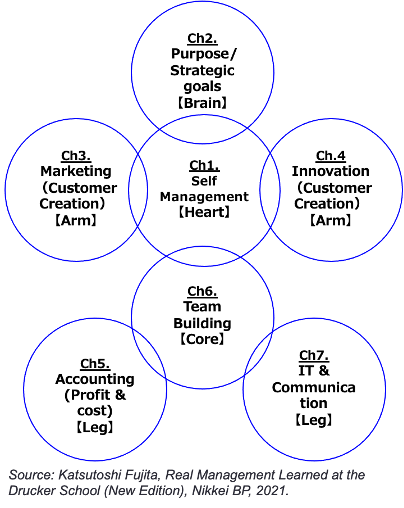
I sought to integrate and fuse the teachings of Professor Drucker and the faculty who carry on his legacy to help Japanese readers understand the “big picture” of management and how each element is connected. Actually, this diagram wasn’t in the original draft. After finishing the manuscript, I mapped the connections between chapters and realized they took the shape of a human body. This convinced me that management is exactly that—a human and holistic endeavor. It requires leadership with high integrity, integrating elements rather than fragmenting them.
The starting point, as written in Chapter 1, is “Self-Management”—treating yourself as a precious resource and utilizing it to the fullest. This is the “Heart” of the human body. If the heart isn’t beating, you cannot exercise true leadership no matter how much you strengthen other management functions. “It all starts with self-management” was a vital lesson from the Drucker School, so I made it the theme of Chapter 1 (though, to be honest, I had to have long discussions with my editor because the idea of starting with the “self” is still hard for many in Japan to grasp). In Chapter 2, I wrote about shifting one’s vision from personal purpose to the organization’s mission and strategic goals—how to set and articulate management’s purpose. Chapters 3 and 4 cover the customer-creation functions essential to any business: Marketing and Innovation. These act like the right and left arms of the organization. However, a body doesn’t move effectively if only the upper half is strong. Chapter 6 covers “Team Building” and organizational revitalization—the “Core” of the body. Finally, Chapters 5 and 7 cover Accounting, IT, and Communication. As I learned at the Drucker School, these are never ends in themselves; they serve as the “Legs” that allow an organization to move quickly and powerfully toward its goals. By visualizing the relationship between self-leadership and management in this integrated way, my conversations with Japanese managers have become much more productive, making it easier to establish common ground.
The Potential of Leadership and Management Education
Professor Drucker and the faculty taught me that “every function of management should be connected and integrated.” Let me share one anecdote. During my time at the Drucker School, Professor Drucker held a dialogue session with the students. One student asked him to describe the Drucker School’s strength succinctly. Professor Drucker replied, “We work together.”
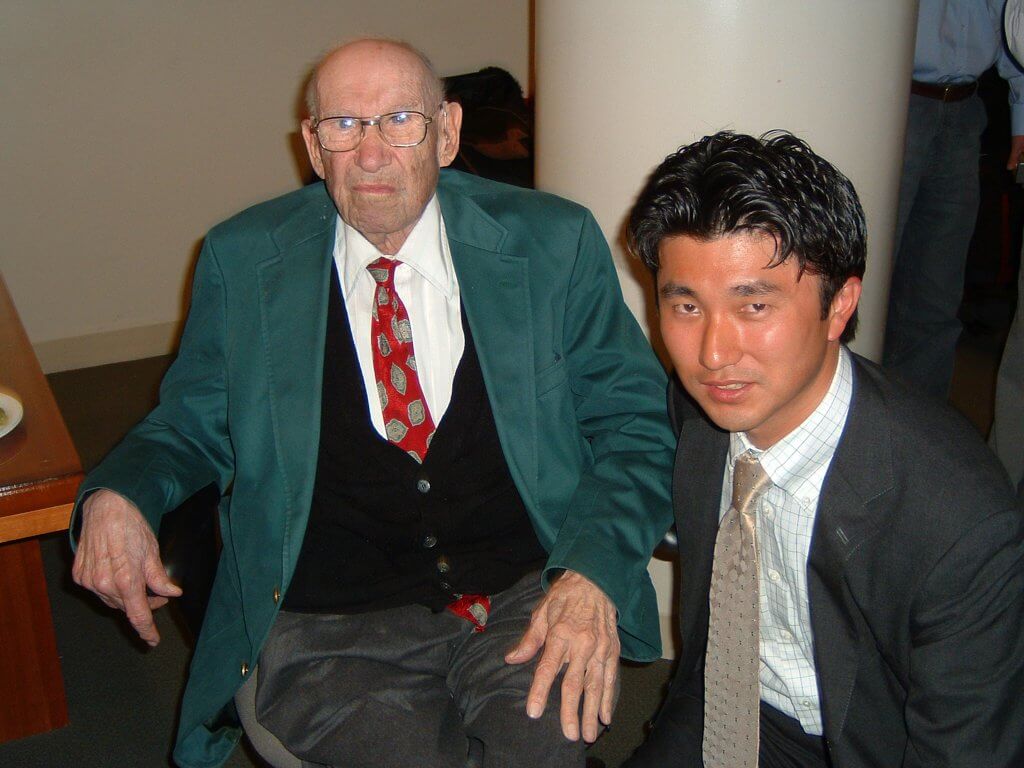
At the time, I didn’t immediately grasp the meaning. Isn’t it natural for faculty and staff to collaborate? But gradually, I understood. Professor Drucker was talking about the unique character of the school: how experts from various fields gather and work hard every day to discuss and collaborate for the sake of “developing great leaders and managers.” This is harder than it sounds. Both management education and research have become highly “fragmented,” making it difficult to see the connections. Japan is no exception. Silos exist not just in research but in organizations as well, often obscuring the whole. Even if Finance, HR, and Marketing operate efficiently, the question of “how we collaborate to create value” often gets drowned out. A famous professor who taught finance at the Drucker School once said:
“I used to teach at a much larger school, and it was easier there. As a finance expert, I only had to teach finance. But here at the Drucker School, when I talk about finance, I get questions from the strategy faculty, and sometimes even the ethics faculty. To be honest, it’s tough, but it’s an exciting environment.”
When I heard this, I felt, “This is true leadership and management education.” Each leader’s values connect with the organization’s mission, and the strategic goals to achieve that mission become clear. When these are organically linked with marketing, innovation, accounting, finance, organizational behavior, IT, and communication, truly valuable “results” are born. This is management with “high integrity.” It is management that not only holds high ethical standards but also provides value and continues to create customers. It is management that values both humanity and productivity. This is the essence of management I learned at the Drucker School.
This is why I want to continue sharing these teachings in Japan to increase the number of attractive businesses and organizations. I look forward to continuing my cooperation with the Drucker School to expand these possibilities further. I believe that by having more people exercise leadership with integrity and practice organizational management with integrity, we can contribute to a prosperous industrial society and world peace.
How the Drucker School Shaped My Work
Finally, I would like to share how my learning at the Drucker School has influenced my career in management consulting and education. Without a doubt, the greatest asset I gained was a deep understanding of the wholeness and foundational principles of management. This grounding enables me to provide consistent and coherent advice to clients facing a wide range of management challenges. Furthermore, in my teaching, even when covering specific management skills, I can always connect them back to the overall purpose of management. I believe the Drucker School’s unique value lies in the opportunity to learn general management, rather than isolated business techniques.
This approach is particularly valuable in today’s environment. As business tactics change rapidly due to advancements in technology, including AI, we must avoid getting overly distracted by passing trends. Instead, we are called upon to address universally important questions, such as “What is the ideal state of management?” and “What defines good, effective management?”
My unique strength is confidently deepening these dialogues and offering sound recommendations. This is undeniably thanks to the time I spent learning at the Drucker School alongside my professors, classmates, and the school staff. I approach my work every day with profound gratitude for this experience.
Learn More
At the Drucker School of Management, finance, strategy, marketing, and human-centered management are taught in connection with one another. Explore our graduate programs or request more information.
About the Author
Katsutoshi Fujita (MBA ’04) is the CEO of Manage For Good Inc. (formerly Project Initiative Co., Ltd.), a firm in Japan specializing in management consulting, executive education, and entrepreneurship education. He is a Specially Appointed Professor in the Faculty of Business Design at Momoyama Gakuin University and an Affiliate Professor in the Research Organization of Science and Technology at Ritsumeikan University. He is the author of Real Management Learned at the Drucker School (Nikkei BP, new edition 2021; currently available only in Japanese).