Remembering Dean McKay, Alumnus and Friend of the Drucker School
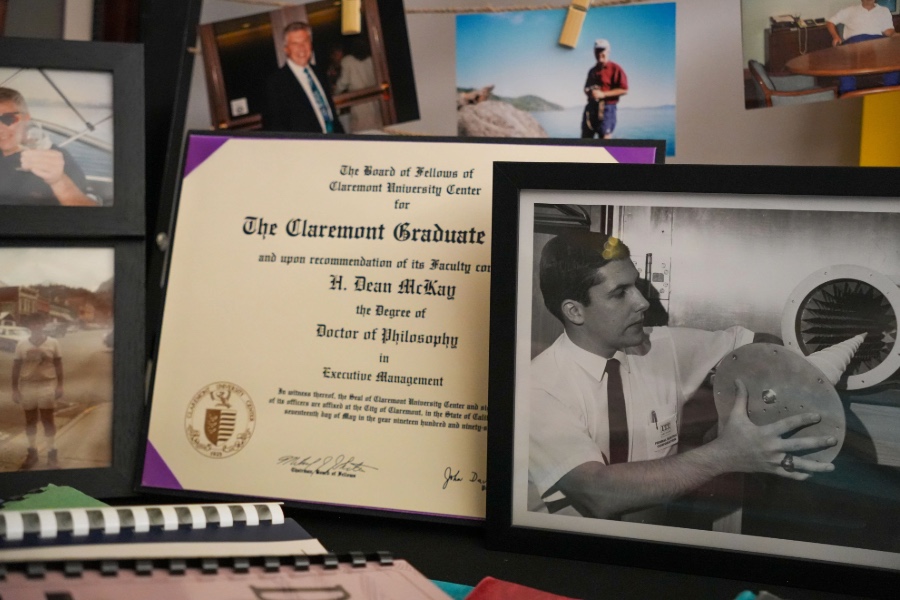
A NASA engineer turned executive and strategist, Dean McKay (MA ’87, PhD ’97) studied under Peter Drucker, drove him to meetings for years, and spent the decades afterward bringing what he heard back to the Drucker School.
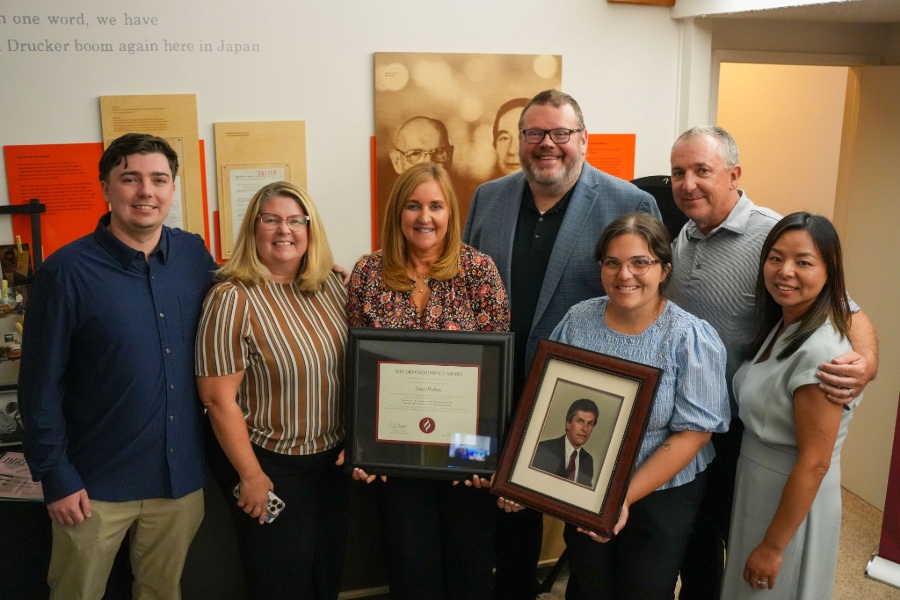
On September 30, members of the Drucker School Advisory Board gathered with Dean McKay’s family at the Drucker House Museum, Peter Drucker’s former home in Claremont, to remember a friend. McKay, who died in January, earned a master’s in executive management in 1987 and a PhD in executive management in 1997 from what is now the Peter F. Drucker and Masatoshi Ito Graduate School of Management at Claremont Graduate University (CGU), and he served on the school’s advisory board. During the evening, David Sprott, Henry Y. Hwang Dean of the Drucker School of Management, presented the McKay family with the Drucker Impact Award, given posthumously in recognition of his decades of service to the school.
The house had a history for McKay. Sprott recalled McKay telling him that, over the years he spent picking Drucker up at the curb and dropping him off again, he never went inside. He first walked through the door after Drucker died in 2005.
The Drives With Peter Drucker
McKay completed his doctorate under Drucker and, by his own account, studied with Drucker and Professor Joseph A. Maciariello for about a decade. He also worked alongside Drucker on the President’s Roundtable, a group of Southern California executives, many of them from aerospace and technology companies, that Drucker advised. Drucker did not like to drive, so McKay drove him.
“According to Dean, Drucker would talk, and Dean would listen, and he learned an awful lot on those drives,” said his wife, Susan Mix, who joined the gathering by video. In recent years, McKay had been writing those memories down so that the school and his family would have them.
His son Robert McKay, the oldest of his children, met Drucker at sixteen and said the ideas followed his father home. “We had many dinner conversations that revolved around things you all know every single day,” he told the board. “We kind of learned them by osmosis.”
“I think driving around with Peter for all those hours and days and years really did affect the trajectory of his life,” Sprott said.
Who Was Dean McKay?
McKay was an only child who grew up in Highland Park, Texas, and earned a bachelor’s degree in mathematics from the University of Texas at Arlington. In the 1960s, he worked on NASA’s Saturn/Apollo program at Cape Canaveral. Robert McKay said his father would never sit through films about the space race, because he had been there for the real thing.
He moved from NASA into aerospace and defense, first near Washington, D.C., then to Southern California, where he became vice president at Aerojet Electrosystems and Allied Signal, and later chief executive officer and president of Whittaker Zyplex. He went on to advise companies on strategy and governance, led more than 400 strategy sessions over four decades, helped start more than a dozen technology companies, and served on corporate boards. He called his approach “10X,” for strategies meant to improve a business by an order of magnitude.
He also taught. McKay was an associate professor of management at Golden Gate University from 1997 to 2002, and in 2008 Adams Media published Business Words You Should Know, which he wrote with P.T. Shank.
Synthia Molina, a longtime board member who once directed the Drucker MBA program, crossed paths with McKay at the school for forty years. “He had some qualities that reminded me a lot of Drucker, in his ability to draw ideas from multiple disciplines and tie them together,” she said. She listed the disciplines: mathematics, physics, electrical engineering, systems engineering, and then management.
Service on the Advisory Board
McKay stayed close to the school for the rest of his life. Board member Allen Sugerman, who knew him for a dozen years and proposed the tribute, worked with him on white papers and board projects and remembered long, lively conversations about strategic planning and the future of the Drucker School. “He was absolutely passionate about Drucker,” Sugerman said. “Every time I talked to him, that is the way he was.”
He often joined board meetings by video from his home in Tahoe City, California, and colleagues remembered the moment he would ask to weigh in. Robert McKay described the same habit at home: a conversation that began with the expectation that his father would agree and then went somewhere else entirely.
McKay also kept writing about Drucker. His essay for Drucker+, “Why Apple Is #1,” argues that the company’s long run at the top reflects Drucker’s principles and draws on his years on the President’s Roundtable. Mix proofread his work, and the last piece she read for him was an article on Drucker and the value of asking naive questions. Within the first three sentences, she found the phrase “native questions” and called him. He sighed. An AI tool had changed every “naive” to “native,” he told her, and he would have to go back and fix them all.
“Don’t Get Frustrated, Be Fascinated”
His family described a man who tried everything: skiing, fly fishing, backpacking, motorcycles, stamp collecting, and a family tree he worked on for years. His granddaughter Carly remembered flying alone to Lake Tahoe as a child and spending hours kayaking with him, nearly tipping over more than once. He took her up her first ski hill, too.
His daughter Mandy said that when she got in trouble, her father assigned essays, and she wrote many of them. She said he was calm, and he had a line for hard days that she has carried ever since: “Don’t get frustrated, be fascinated.”
“He was a big thinker and a big dreamer,” Robert McKay said. “He had a wonderful life, and he gave a lot of people a wonderful life.”
McKay is survived by his wife, Susan Mix, and by their children, grandchildren, and great-grandchildren.