How MBA Applications Are Evaluated: An Inside Look at Drucker School Admissions
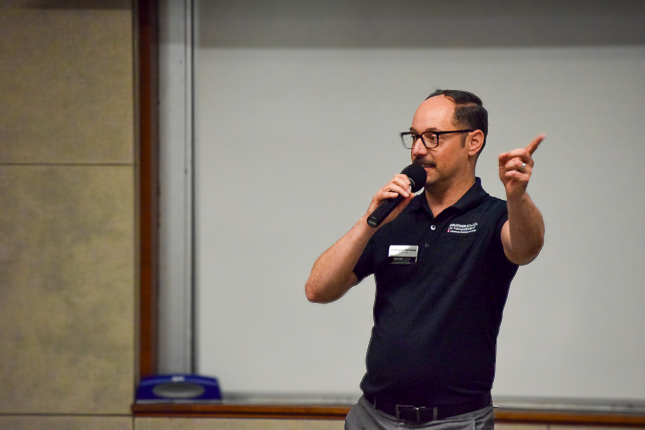
Andrew Henkes, Associate Dean of the Drucker School at Claremont Graduate University, explains how the admissions committee reviews MBA applications, what makes a strong candidate, and why the process at Drucker looks different from most business schools.
MBA admissions can feel opaque. Between GMAT scores, GPA minimums, essays, interviews, and letters of recommendation, many applicants never learn what admissions committees actually weigh — or how much weight each element carries.
At the Peter F. Drucker and Masatoshi Ito Graduate School of Management, the MBA admissions process is intentionally structured to answer those questions directly. There are no score cutoffs. Every application is read in full. Every applicant who completes an application is interviewed. And the framework used to evaluate candidates draws directly from Peter Drucker’s conviction that management is, first and foremost, a human practice.
We sat down with Andrew Henkes, Associate Dean of the Drucker School, for a candid conversation about how MBA applications are reviewed at Drucker, what distinguishes a strong applicant, and what prospective students most often get wrong about the admissions process.
How the Drucker MBA admissions process works
What are the steps in the Drucker MBA admissions process?
The first step is to connect with a Drucker recruiter. Recruiters are there to understand your interests and help match you with the right program. From there, you submit your application materials, complete an interview, and wait for a decision as the committee weighs every piece of the application together.
“The earliest stage is really about getting to know each other,” Henkes says. “Your goals, the kind of experience you’re looking for, your background — we want to understand all of that so we can help you identify the right pathway. It’s less of a transaction and more of a conversation.”
How MBA applications are reviewed at Drucker
How are MBA applications evaluated?
“A lot of business schools use minimum thresholds for things like GMAT or GPA,” Henkes explains. “We don’t have any hard requirements beyond what’s listed on our website. We weigh every aspect of your application together.”
The committee considers five elements:
- The applicant questionnaire, which serves as Drucker’s version of the MBA application essays.
- Academic transcripts and GPA.
- The admissions interview, required of every completed application.
- Test scores (GMAT, GRE, or others), which are optional or waivable for many programs.
- Work and life experience, evaluated broadly rather than against a corporate checklist.
Each element is scored on its own merits, then combined into a full-picture view of the candidate.
How is Drucker’s admissions process different from other MBA programs?
Two things set Drucker’s MBA admissions process apart: no artificial cutoffs, and an interview for every completed application.
“Many schools receive far more applications than they can spend real time on, so they create arbitrary initial boundaries,” Henkes says. “If you don’t meet some combination of GPA and test score, they won’t look at the rest of your application. We look at every application in its totality.”
We look at every single application in its totality, and we interview every candidate who completes an application. The interview is the most important piece of the process for us.
— Andrew Henkes, Associate Dean, Drucker School of Management
That level of attention is possible because of Drucker’s deliberately small size — a characteristic that shapes both the admissions experience and the classroom. “We don’t take for granted that who you are can be captured by a couple of quantitative metrics,” Henkes says.
What makes a strong MBA application at Drucker
What do MBA programs look for in applicants?
At Drucker, a competitive MBA applicant shares the school’s core belief that management is ultimately about people — and that organizations exist to fulfill a functional purpose in the world. Within that philosophy, the admissions committee looks for five signals:
- Self-awareness and the ability to articulate who you are and what you value.
- A clear sense of what you want from the MBA experience, in both the short and long term.
- Alignment with Drucker’s human-centered approach to management.
- Meaningful work or life experience, defined broadly.
- The capacity for self-management — a principle Peter Drucker identified as the starting point of managing others.
“Candidates who can articulate who they are, what their values are, and how the degree fits into their short- and long-term goals will stand out,” Henkes says. “Ultimately, we’re trying to build a class that will engage meaningfully with our approach to management.”
How does Drucker’s human-centered philosophy shape admissions?
Drucker’s foundation in management as a liberal art shows up directly in who gets admitted. The school has a long track record of welcoming candidates with nontraditional paths — at a time when many competitors would not.
“At a time when other business schools wouldn’t consider applicants without a corporate background, we had a broad sense of what counted as meaningful work experience,” Henkes says. “A freelance graphic designer might have been turned away by regional competitors. We see that as real work experience.”
That breadth reflects Drucker’s own teaching: management principles apply to for-profit companies, nonprofits, NGOs, and government alike. Drucker students today come from different parts of the country and the world, with different industries and career goals. The school does not recruit for specific industries. It looks for shared values and clear direction.
What signals tell admissions you’re ready for an MBA?
Some parts of the application are locked in — GPA, test scores, past work history. But the questionnaire and the interview are where readiness actually shows. Readiness, at Drucker, means knowing what you want from the program, why now, and how this degree moves your goals forward.
“Not everyone needs to walk in knowing they want to be a marketing manager or a financial advisor,” Henkes says. “But having a clear sense of what you want — and how our program maps to your values — makes a real difference. Not every MBA is right for every person. Knowing we’re a good match for you goes a long way.”
Inside the MBA application: essays, recommendations, and the interview
What role does the MBA application essay play?
Drucker’s applicant questionnaire is the school’s version of the MBA essay — short, focused, and designed to reveal self-reflection rather than life story.
“The questionnaire is really important,” Henkes says. “It’s your chance to articulate your goals, your vision for yourself, and how well you align with the school. A transcript and a resume don’t fully tell your story. The questionnaire does.”
Applicants often underestimate the form. “Because it’s short, people assume it’s easier. Short is actually harder. It requires you to transmit a lot of information in a small space.” Henkes is emphatic on what the questionnaire is — and is not. It is a graduate-level statement of purpose. It is not a personal statement. “We don’t want your life story or your favorite memories from high school. We want to know your values, what you want to accomplish, and how you’ll contribute to the program.”
One question asks what you will contribute. That isn’t primarily about industry connections or a resume credential. It is about how you see yourself — what you have accomplished, what skills and values you bring. Another asks how you’ll be successful. The most effective answers are clear, question-focused, and specific.
What makes a strong MBA letter of recommendation?
Drucker no longer requires letters of recommendation. For applicants who choose to submit one, the strongest recommendations come from a professional advocate who knows your work well — not a senior name who barely does.
“We’d much rather hear from a direct supervisor who genuinely knows your work — ‘She’s thoughtful, hardworking, and here’s a project she led’ — than from a high-ranking CEO who barely knows you,” Henkes says.
The relationship should be professional rather than personal: not a family member, not a friend, and ideally not a church or social-club contact unless you held a formal role there. For earlier-career applicants, an academic reference can work well — provided the professor actually knows you, rather than barely remembering you from a crowded lecture hall.
What is the purpose of the MBA admissions interview?
The Drucker admissions interview is the deepest point of contact in the application process. It is where the committee assesses how candidates think about themselves, how clearly they communicate, and how well they can articulate their values on the spot.
“For us, the interview isn’t a hurdle to clear,” Henkes says. “It’s the part of the process we value most.”
When to apply and how to prepare
When is the right time to apply for an MBA?
The right time varies. Often, the strongest moment to apply is when you’re ready for a change — a promotion, a pivot to a new role, or a shift to a new industry. An MBA can be the credential that makes that move real.
Drucker sees fewer purely traditional full-time students than in decades past — taking two years away from work has become more of a luxury. Some applicants enter directly after undergrad to avoid interrupting a career later. Others treat a transition between jobs as a natural entry point.
More work experience is valuable for two reasons. First, it gives you more to bring into the classroom — the MBA is meant to complement professional experience, not replace it. Second, experience tends to sharpen self-knowledge, which is what the questionnaire and interview are designed to surface.
What are common misconceptions about MBA admissions?
The most common misconception is that every MBA program is the same. It isn’t. Programs differ in concentrations, industry connections, regional strengths, and philosophical orientation.
A second misconception: that the MBA is only for people pursuing high-paid corporate careers — consulting, investment banking, big finance. “The MBA can serve people entering many different industries and types of roles,” Henkes says. “When applicants don’t see themselves in that narrow corporate picture, they sometimes rule out the MBA entirely when it would actually be a great fit.”
How can applicants know if they’re competitive?
Henkes pushes back on the framing itself. “‘Competitive’ isn’t the right word for us. At some schools, competitiveness is about clearing artificial hurdles — test-score cutoffs, GPA minimums, Fortune 500 names on your resume. We don’t set up those barriers.”
What replaces it is readiness. Are you ready for graduate management education? Do you know what you want from the degree? Can you use it meaningfully when you’re done? “Focus on telling your story,” Henkes says. “And work closely with our recruiters. They’re here to help you write a successful application.”
What’s the best advice for MBA applicants?
Henkes offers two pieces of advice. First: talk to a lot of different schools. Comparison sharpens your sense of what you actually want. Second: treat the Drucker recruiter as a partner, not a salesperson. “Don’t treat them like a salesperson you’re trying to manage. Let them be a partner in the process. Their job is to help you understand what Drucker is about.”
Above all, he says, spend time reflecting before you sit down to write. “The more reflection you’ve done before you arrive at the application, the stronger the application will be.”
Take the next step toward your MBA at the Drucker School
The best applications start with a conversation. Whether you’re just beginning to explore the MBA or ready to apply, our admissions team can help you understand your options, identify the right program, and prepare a strong application.
- Connect with a Drucker recruiter to talk through your goals and ask questions one-on-one.
- Explore our MBA and master’s programs to find the pathway that fits your career stage and ambitions.
- Attend an upcoming information session or campus visit to experience the Drucker community firsthand.
Ready when you are. Start the conversation at cgu.edu/admissions.