Behind the Bread: What Tradwives Are Actually Selling
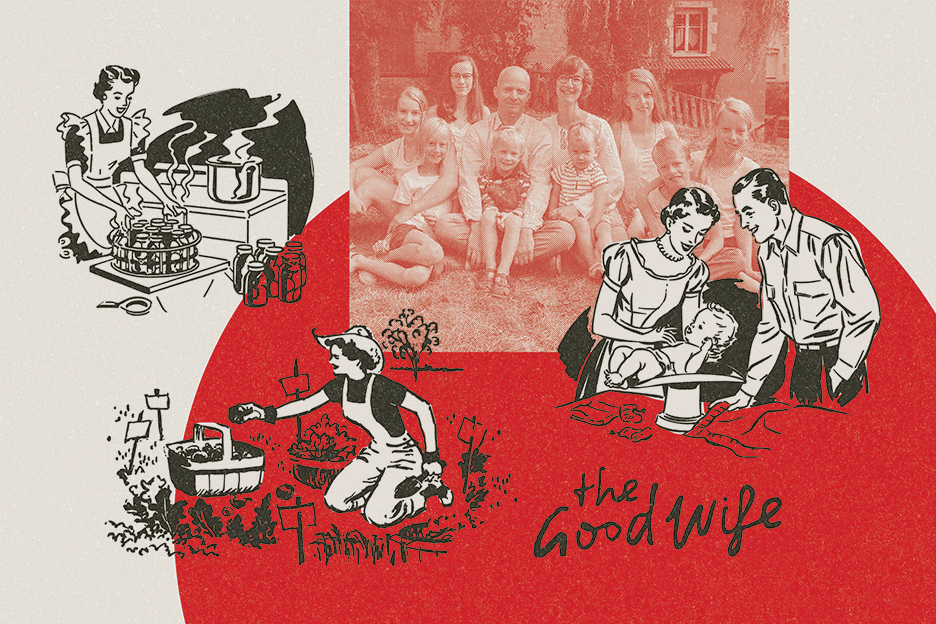
A Claremont Graduate University scholar explains why the tradwife trend is less about domesticity than digital entrepreneurship — and why Latter-day Saint women have become some of its most prominent figures.
The image is familiar: a woman in a flowing dress pulling fresh bread from a farmhouse oven, her kitchen immaculate, her children rosy-cheeked nearby. The caption might invoke gratitude, simplicity, or the quiet dignity of homemaking. And somewhere in the frame, there is almost always a brand partnership.
That is what Caroline Kline wants people to understand about the tradwife trend: it is, at its core, a content business.
“Tradwives are not a demographic group,” said Kline, a research assistant professor at Claremont Graduate University’s School of Arts & Humanities who teaches courses on gender and Mormonism. “They are rather more like a social media trend. When we talk about tradwives, we are not talking about stay-at-home mothers. We are talking about influencers who deliberately curate and monetize this very stylized vision of domestic life.”
The distinction matters. As tradwife content has grown from a niche corner of the internet into a mainstream cultural touchstone, generating millions of followers, major sponsorship deals, and sustained media coverage, the conversation around it has often collapsed the category, treating social media personalities as proxies for every woman who prioritizes home and family. Kline’s research cuts through that conflation, situating tradwife content within the economics of the attention industry while tracing its deeper roots in American religious and regional mythology.
Her area of particular focus: why Latter-day Saint women have emerged as some of the tradwife space’s most successful and visible figures.
A Theology Built for This Moment
Kline, who teaches “Gender in Mormonism” and “Podcasting Global Mormonism” at CGU, argues that the alignment between tradwife content and Latter-day Saint culture is not coincidental. Mormonism, she explains, has a long and doctrinally grounded emphasis on family, motherhood, and domestic life, values that translate with unusual ease into the aesthetics and messaging of tradwife media.
“When you put together both this theological emphasis on family and motherhood combined with a cultural emphasis on the same, along with women who are extremely competent and good speakers and good writers and know how to organize, you have yourself women who are very well-positioned to do quite well in the social media influencer space of tradwives,” Kline said.
That competency, she is careful to note, does not arise from homemaking alone. LDS women, she observes, are statistically well-educated and frequently develop substantial organizational and communication skills through service in church communities, skills that translate directly into building and sustaining an online audience.
@naraazizasmith soo good! 🫶🏽 #easyrecipe #homecooking #fypツ #momtok #toddlersoftiktok #juice
The path from congregation to content creation also has a historical precedent. Mormon women were among the earliest adopters of mommy blogging when the format emerged in the early 2000s, documenting family life, sharing photographs of their homes, and building digital communities around the rhythms of domestic experience. That tradition of public self-documentation has a theological dimension as well: members of the Church of Jesus Christ of Latter-day Saints are encouraged to keep journals and record their lives — a cultural norm that primed LDS women for the shift to image-driven social platforms.
The content, however, has changed significantly. Early mommy blogging was, in Kline’s description, confessional and honest, “writing about the messiness of motherhood,” with candid accounts of tantrums and chaotic households. Tradwife content operates under a different logic entirely, one organized around aspiration and visual polish rather than solidarity and authenticity.
The Escapism Economy
That shift in register, Kline argues, is central to understanding the appeal of tradwife content and the cultural anxieties it speaks to.
“Tradwife content is so compelling right now because it’s offering a vision of life that is just unavailable to most women in America,” she said. “It’s time with children. It’s time to cultivate beauty. It’s time that these women have to bake and to cook. And of course, women who are working today or dealing with other responsibilities often feel burned out.”
The emotional template of tradwife content, its cultivation of serenity, beauty, and apparent effortlessness, functions as a kind of fantasy projection, offering viewers a world without financial stress, household chaos, or professional burnout. In that sense, Kline positions it alongside other forms of media escapism, products not primarily of ideology but of market demand.
@ballerinafarm Spend the day with me (and a little of the next day) while I make sourdough. This is my original recipe except for I used 900g of our farm flour and 100g of rye flour.
There is also, she notes, a more grounded element to tradwife content’s appeal: its visible relationship to production. In an era when most food arrives pre-packaged and pre-processed, watching someone make pasta from scratch or raise animals on a working farm can feel genuinely revelatory to viewers with no personal connection to those practices.
“I think that can be something really fascinating to women who are not used to this, who maybe did not grow up in a household where their moms or dads were cooking from scratch,” Kline said. “I think that often draws women in who just have never engaged in this kind of work.”
Two Mythologies, One Feed
The ideological texture of tradwife content is not uniform. Kline identifies a spectrum running from content that explicitly frames female submission within a Christian conservative framework to material that is simply aesthetic, celebrating domestic femininity without overt theological argument. What unites it, she suggests, is a shared set of cultural mythologies being drawn upon and remixed for a digital audience.
The first is the mythology of Mormon womanhood: women as spiritual anchors of the home, self-sacrificing, devoted, family-centered. The second is the mythology of the American West: the pioneer woman, resilient and resourceful, close to the land, capable of making something from nothing.
Figures like Hannah Neeleman of Ballerina Farm, who operates a large working farm in Utah while raising a prominent public profile, and Nara Smith, another LDS tradwife influencer with tens of millions of followers, embody both mythologies simultaneously, or at least project their visual and emotional codes.
But Kline is emphatic that mythology and economics must be held in tension. “While this content is presenting these gender roles and hearkening back to ideals of the American West or Mormon womanhood, I always keep in mind that these are very smart businesswomen who are monetizing this content,” she said.
That tension produces what she identifies as a genuine paradox at the heart of the tradwife phenomenon. These women promote, implicitly or explicitly, a vision of femininity organized around male provision and female domesticity, while simultaneously operating as independent earners.
“By promoting themselves, their businesses, their products, these ladies are businesswomen,” Kline said. “They’re not confining themselves to a domestic role in which only their husbands make the money. So, they are thrusting themselves into this world of money and the economy.”
What the Trend Reveals
For Kline, the tradwife phenomenon is most productively understood not as evidence of a mass ideological shift toward traditional gender roles, but as a mirror held up to the pressures and aspirations of contemporary life and as a case study in how digital platforms transform identity, belief, and community into content.
The LDS women who have become the trend’s most recognizable faces, she argues, are not simply expressions of their faith’s gender theology. They are entrepreneurs who have recognized a market, assembled a skill set, and built substantial media enterprises around the cultural assets their background provides.
That recognition does not require one to endorse the messages some tradwife content carries, Kline is clear-eyed about the ideological freight some of it bears, but it does demand a more precise analysis than the trend typically receives in popular discourse. The woman in the farmhouse kitchen may be offering a vision of serenity. She is also, in all likelihood, running a business.
Caroline Kline is a research assistant professor in the School of Arts & Humanities at Claremont Graduate University, where she teaches courses on gender and Mormonism. Her “Ask an Academic” segment on tradwives is available on CGU’s social media channels.