Adding ‘Doctor’ to a Lifetime of Roles and Distinctions
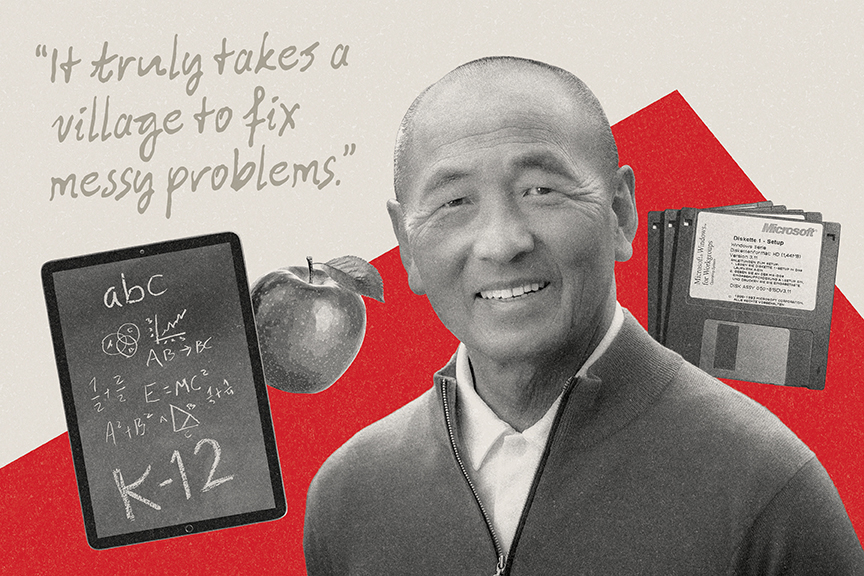
Former Microsoft Executive Scott Oki Reflects on His Pursuit of a Doctorate in Education at 77 YEARS OF AGE.
Scott Fitzgerald famously wrote that “there are no second acts in American lives.” Had he met Scott Oki, he might have reconsidered.
Oki’s first act was remarkable enough. As an early Microsoft executive, he played an integral role in helping transform a young software company into a global brand. But that was only the beginning. In the decades since, other acts have included his becoming a philanthropist and advocate for children, an entrepreneur, a university regent, a published poet, and a nonprofit founder. This fall, at age 78, he will add another title to the list when he earns his PhD in Education from Claremont Graduate University.
For Oki, the common thread running through each chapter of his life has never been achievement for its own sake. It has been about the pursuit of meaningful impact.
“Ever since I retired from Microsoft in 1992, I’ve wanted to do things where I knew I might make a difference,” he said. “If I ever became involved in something and didn’t feel I could make a difference, I would remove myself and look for something else.”
That philosophy has guided decades of his community service. Earlier this year, Oki was named the recipient of the 2026 Blake Nordstrom Humanitarian of the Year Award by the Puget Sound Business Journal, honoring his longstanding commitment to philanthropy and volunteer leadership. Over the years, he has served on more than 100 nonprofit boards and founded 22 organizations of his own.
“Philanthropy work has always been the easy part. It’s just about writing a check,” Oki said. “But being a volunteer is more time consuming. You can always make more money; you can’t make more time. So I’ve always looked for organizations and issues where giving my time would have an impact.”
Among the organizations he has launched are The Oki Foundation, which supports children’s health, education, and human services, and the Breaking Barriers Foundation, which uses breakdancing to help young people who are facing adversity.
In recognition of Oki’s selection for the Nordstrom award, many of the congratulatory voices included his longtime associate Mario Chaves, a software industry executive who on LinkedIn commended Oki and his family for turning to philanthropy “as their next adventure to help make the world a better place for others.”
An Eye on Education
Although his interests have been wide-ranging, Oki has consistently returned to one issue: K–12 public education.
Raised in a modest second-generation Japanese American family in Washington state, Oki benefited from the public school system and remains deeply concerned about its challenges today. Through his foundation work, service on education-focused policy committees, and even the publication of his 2009 book Outrageous Learning: An Education Manifesto, he has spent years exploring ways to improve educational outcomes.
Yet Oki came to believe that studying the problem and advocating for change were not enough.
“The one thing I felt I was missing was credibility in the field,” he said. When he expressed his thought to his family, Oki said their response was clear and straightforward: Go and get some credibility then.
That eventually led him to CGU.
A chance conversation at a Seattle-area event with Tim Kirley, former board chair and interim president of CGU, introduced Oki to the university’s renowned education program. Kirley connected him with School of Educational Studies Dean DeLacy Ganley, who understood both Oki’s sense of urgency and his ambition to make a difference while there was still time to do so.
Together, they designed a rigorous path to degree completion. Oki now carries a five-course semester load—something he jokes is the hardest he has worked since the 100-plus-hour weeks of his Microsoft days.
“CGU has been extremely accommodating. It’s a great program,” he said. “I’ve learned a lot—not just from my fellow students, but from the professors. They really understand the teaching process, what students are experiencing, and what they need to succeed.”
Jumping In With Both Feet
This fall, Oki expects to defend his dissertation, which examines the factors influencing the adoption of artificial intelligence by secondary mathematics teachers.
For Ganley, Oki has been fearless in his pursuit of something greater than simply a grade or a doctoral degree. What he wants, she says, is knowledge and understanding, and he has never hesitated to immerse himself deeply in a subject.
“Scott’s not someone who tentatively dips a toe into a subject—he jumps in with both feet,” she said. “With me, he never asked what he needed to know just so he could pass a class. He wanted to know what he needed in order to learn. There’s a big difference there. For him, it has always been about how he can go deeper into a topic, and we’ve done our best to keep up with him.”
Ganley also noted the camaraderie and collegiality among Oki and his classmates, many of whom are working teachers and administrators intensely focused on applying what they learn to the situations they encounter every day.
“He’s gotten along so well and become a beloved member of our program,” she said. “Scott is such a great example of how there really is no time limit or restriction on when someone should decide to start graduate school—or how long it takes them. It doesn’t matter where you are in life or your age or any other factor. If you have the commitment and are willing to keep making progress, we’ll work with you and meet you wherever you are.”
His Next Act
For Oki, his education doctorate is not a capstone but a launching point.
He hopes to use what he has learned for still another act in his professional career: to help improve Washington’s K–12 public schools. The solution, he believes, is not simply increased funding but meaningful collaboration among educators, policymakers, families, and community leaders.
“It truly takes a village to fix messy problems,” he said. “You have to bring together all the parties that can make an impact. Put them around the table, agree on the goals, get buy-in from everyone, set strategy, and then execute.”
Oki knows meaningful change rarely happens quickly. Still, if his efforts can move the needle even slightly, he will consider them worthwhile.
“I know this won’t happen overnight,” he said. “It’s going to take time. If I can work on this for the next ten years and see some positive impact while I’m still around, that would be incredibly meaningful to me.”