Two Cities, One Global Network
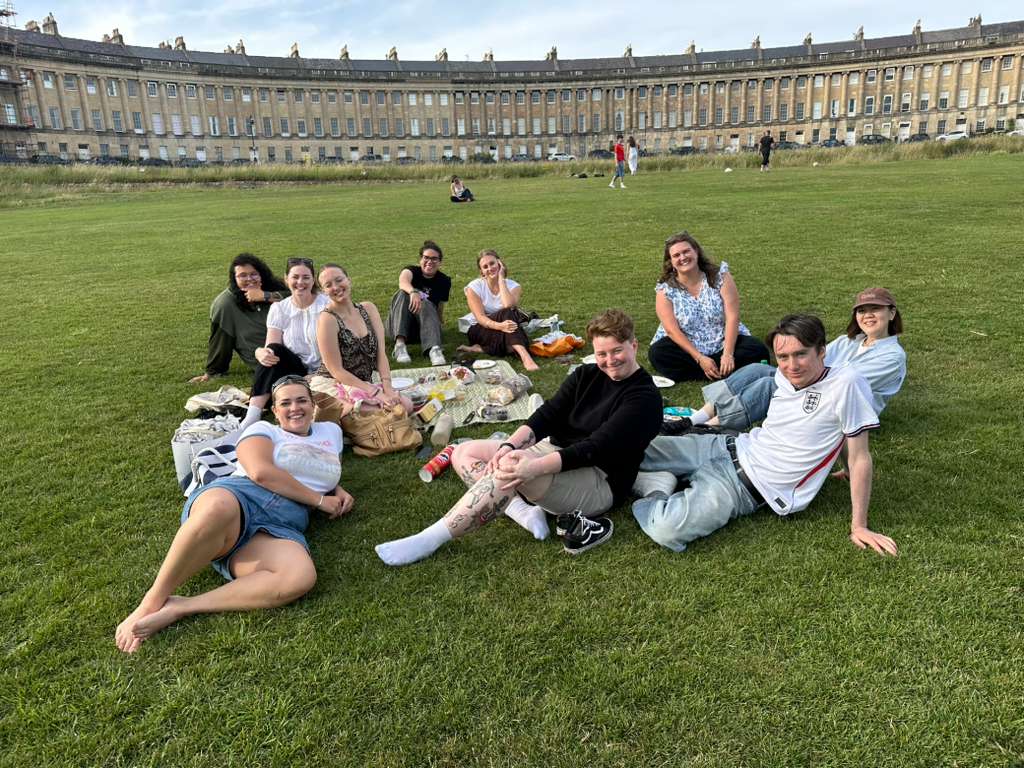
How one graduate course turned a study of two cities into an international network.
There’s a steady stream of coaches on the road from London to Stonehenge, each packed with tourists who seem drawn more by obligation than curiosity about seeing the stones.
After more than a decade of taking the trip, Josh Goode, Professor of History and Cultural Studies, still brings in his own words, “an eight-year-old sensibility” to Stonehenge.
“Why was it built? It’s a mystery. Was it aliens? Was it people? There’s a reason that Stonehenge is part of the grand tour and it’s partly because it’s an enigma,” Goode says.
Six thousand miles away, in Los Angeles, Goode has a different answer to a version of the same question. Asked why the artist Simon Rodia spent more than 30 years building the Watts Towers out of scrap steel, tile, and broken glass, Goode doesn’t reach for some historical theory. “Simon Rodia’s explanation for why he constructed the Watts Towers over 30-odd years is pretty straightforward. He just wanted to do something big.”
Stonehenge and the Watts Towers are just two of a dozen stops along a route Goode has been refining for years in his course, TNDY 405: Heritage, Culture and Managing the Past in the Old World and New, which pairs graduate students from Claremont Graduate University (CGU) with their counterparts at Bath Spa University in England. “The class is meant to be a study in opposites,” Goode says.
“Los Angeles is a sprawling city that plows over its history to build a strip mall, while Bath is a UNESCO World Heritage city where you can’t change a window sash or a doorknob without council permission.” The course has turned into a kind of running debate about how different societies decide which parts of the past are worth keeping, and who gets to decide.
A Course with Humble Origins
Reflecting on the course’s origins, Goode says it was pretty casual. “Bath Spa’s vice chancellor wanted to put her small, provincial university on the international map. So she called me and basically said, ‘Josh, make something work,'” he recalls with a laugh.
The two of them started mapping out the class curriculum. “We decided to just do a kind of joint class, to walk before we run,” Goode says. Rather than build a credited course across two institutions and two countries, Bath Spa and CGU set it up as an exchange. British graduate students and faculty travel to Los Angeles for a week, visiting historic sites and museums alongside CGU students. Two weeks later, the CGU group flies to Bath and does the same thing.
At each stop, students do more than just tour the spaces. They’re encouraged to talk to the people who run them. “I tell them, walk up to them, shake their hand … Ask them how did you get your job?” Goode says. The answer, almost without exception, is that it wasn’t a straight line. It’s a lesson Goode treats as seriously as anything on the syllabus.
“There isn’t one direct path to their ideal job,” he says. “That’s part of the great joy and value of the humanities, but also one of the hard ways … it’s hard to convince parents that there’s a value in the humanities, because those jobs, you get to them eventually, but there isn’t always a direct path.”
Cognate Sites
Goode has built the itinerary around what he calls “cognate sites,” places in Los Angeles and Bath that let students compare, as directly as possible, how two cities narrate their histories. The Roman Baths, a 2,000-year-old site that still anchors Bath’s tourism economy, are paired against the Getty Villa in the Pacific Palisades, Goode’s stand-in for a full-scale re-creation of the Villa dei Papiri (an actual ancient Roman villa that was buried by the eruption of Mount Vesuvius in AD 79). Stonehenge is paired with the Watts Towers — one a Neolithic mystery, the other explained, however simply, by the man who built it.
A Course in Constant Flux
Though the course is steeped in history, the comparisons haven’t stayed fixed over time. “The ways that history and historical reckoning … the taking down of monuments and memorials … changed, especially after George Floyd, are a facet of this class,” Goode says, noting that it is a way of watching “how conflictive history unfolds in both contexts, often for different reasons. How they are spoken about in similar terms but with different motivations.”
The course has also grown geographically. Through the Global Academy of Liberal Arts Network, CGU added an optional four-day add-on built around the German cities of Bayreuth, Munich, and Nuremberg. Participation has grown quickly since Goode introduced it.
That growth has produced exciting opportunities. Through fundraising Goode has led, the Germanisches Nationalmuseum in Nuremberg now funds two fully paid residential fellowships each summer for CGU students to spend a month working on a museum exhibition or project of their choosing. “I mean, when does that ever happen in academia?” Goode asks. He’s now working to set up similar internships with British museums.
Over a Decade Later, Still Making an Impact
More than 300 CGU students have taken the course, and many, Goode says, get their first passport just for the trip. Three PhD dissertations have grown directly out of the class. The friendships and professional networks it builds, Goode argues, are the real return.
“Our students interact with their future colleagues. From their one class experience, they develop an international network. That’s invaluable and rare in the graduate experience, and it’s built into this class.”
The course was already a few years old when the U.K. voted to leave the European Union in 2016, and Goode says the political climate on both sides of the Atlantic has only made the work feel more urgent. “These kinds of exchanges make the world smaller in a very positive way,” he says. “I think that’s always going to be necessary.”
Looking Ahead
Goode’s ambitions for the course haven’t shrunk. If anything, the German fellowships prove he can turn wishful thinking into funding, so his next goal is bigger still –– a joint exhibition curated with objects and curators from two major museums (the Getty and, variously, the British Museum or the V&A), staged at CGU with the course’s own students working as curatorial assistants. “I’d also like world peace, and I’d like a chicken in everyone’s pot,” he jokes. “But yeah, to me, that’s the fantasy.”
After a decade of comparative history, Goode’s course has built a network of colleagues spanning three countries, produced three dissertations, funded two fellowships in Nuremberg, and sent more than 300 students home from Bath and Los Angeles with a new view of the world. Goode still has his sights set on more, and every new idea he chases only means more of the same for the students who come next. More fellowships, more partnerships, more doors held open.
Rodia wanted to do something big. Ask any of the 300 who’ve come through Goode’s classroom, and they’ll tell you Goode has too.