In St. Croix, the Hidden Toll of a Refinery Falls Hardest on Women
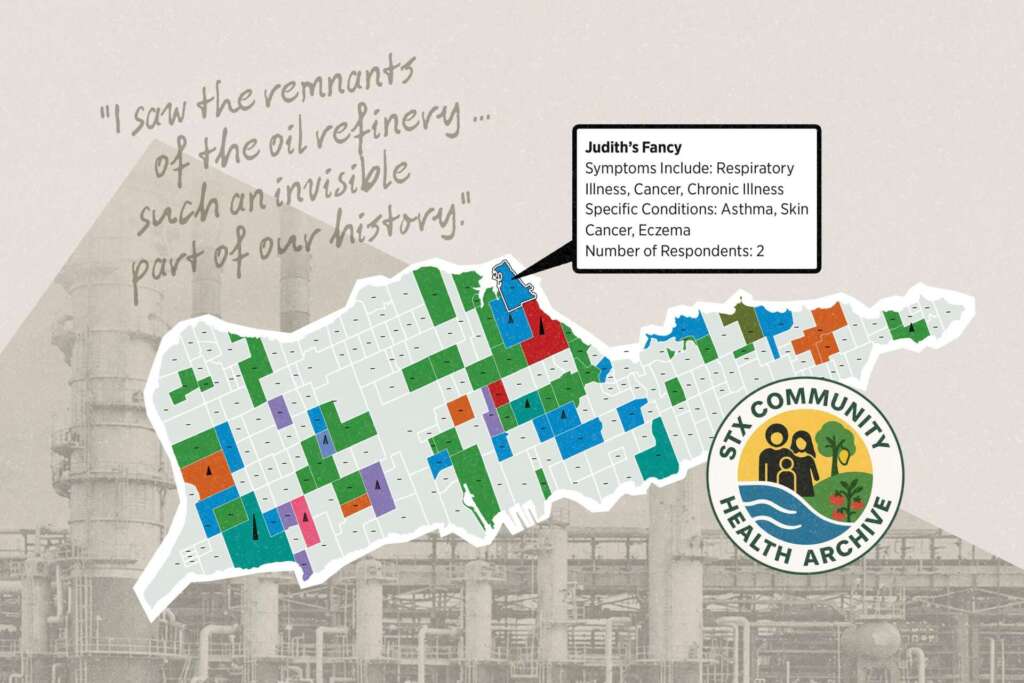
For nearly a decade, History Professor JoAnna Poblete has been piecing together a story that official records left out.
Poblete studies places that have lived under direct U.S. authority without full incorporation into the union — Native Hawaiian communities, Chicano communities in the Southwest, American Samoa, the Philippines, and the U.S. Virgin Islands, which has been an unincorporated territory since 1917.
Her first book examined Filipino and Puerto Rican sugar plantation workers recruited to Hawaii. For her current project, inspiration came from the air.
“I saw the remnants of the oil refinery,” Poblete said, describing a flight between the U.S. Virgin Islands’ main islands. The refinery operated on St. Croix from 1965 to 2012, and for much of that run, it processed a significant share of the gasoline and diesel consumed in the southern and eastern United States — output whose scale, she said, made it “such an invisible part of our history.”
Researchers have studied the refinery’s environmental effects on St. Croix’s water and mangroves, but almost no one, Poblete found, researched what living downwind from it did to the people on the 84-square-mile island. “That’s when I had my aha moment with this project,” she said.
A community archive is born from missing data
Poblete’s method, as in her earlier work, started with oral history — more than 65 interviews with residents of St. Croix. What she found was that no hospital or government body had kept consistent health records tied to the refinery. Only after a major emissions incident would the EPA require local hospitals to report complaints or ER visits, and even then, the time frame was narrow, and the data was never centralized.
“There isn’t a lot of data out there,” Poblete said, which she came to see as the central obstacle facing residents who wanted to prevent the refinery’s repeated attempts to restart.
So, she built the missing archive herself, called the STX Community Health Archive — a free, public, online repository of historical documents and research; much of it recovered by asking residents directly. “Do you have it in your email? Do you have it at your house? I’ll scan it for you. I’ll preserve it. I’ll digitize it,” she said of the process.
The site also hosts a four-lesson unit plan (along with a teacher’s edition) developed with local educators and community leaders, covering territorial status, economic development, and community health in the Virgin Islands, built as a living Google Doc so it can be continually updated for 11th- and 12th-grade classrooms.
Empowered and taking action
Poblete’s 2021 essay “Women Community Warriors of St. Croix,” published in Women, Gender, and Families of Color, argues that despite their near invisibility in standard accounts of oil refining under U.S. colonialism, Crucian women have both contested conventional gender roles and shaped the refinery’s presence in their community on their own terms.
Poblete described two overlapping groups of women affected. The first worked at the refinery as administrative staff or on the janitorial crew, putting them in regular contact with fumes and particulates on-site. The second, larger group absorbed the exposure secondhand: wives, mothers, sisters, and daughters of refinery workers who washed contaminated clothing and cared for family members dealing with rashes, asthma, eye irritation, or cancers linked to the emissions.
That caregiving role, she says, is also what pushed many of these same women into environmental-justice organizing — circulating petitions and holding informal meetings that grew into formal advocacy.
Part of what they were up against, she noted, was a structural incentive: As an unincorporated territory, anything manufactured in the Virgin Islands is legally “made in the USA” and eligible for federal tax and tariff benefits, even though labor laws and EPA standards have not always been enforced there as they are in the United States.
What comes next
Poblete has published two articles from the project so far, with a third underway with her community collaborators and another forthcoming from a Center for Puerto Rican Studies conference. She’s weighing whether to consolidate the work into a book — but not a conventional one.
She described wanting a hybrid structure: a traditional historical narrative section, a section co-authored with her community collaborators, and a section on the methodology and ethics of community-engaged research itself, including how the project shifted from archival work (hampered by heat, humidity, and hurricane damage to physical records) to oral history to the public archive.
She also pointed to the island’s artistic traditions — murals, bamboula dance, mixed media, activist theater — as ways St. Croix keeps the refinery’s legacy in public view, even as residents juggle the more immediate demands of making a living. “These are all … the complications and tensions that everyone is dealing with on a daily basis,” she said.
For now, the archive remains her most immediate tool for change: a stable, central place, she said, so that the evidence “won’t get lost again.”