The Power of Addition
The IMS Community Gathers to Honor One of Its Own and a New Fellowship that’s already Changing Lives
What areas of mathematics has Professor Emeritus John Angus focused on during his career? Probability, statistics, computing, algorithms, and navigation, just to name a few.
But a year after his retirement, following 35 years as a member of the Institute of Mathematical Sciences (IMS), Angus has received a very different—and perhaps more personal—lesson in mathematics involving the power of addition.
Some 43 donors—including former students, colleagues, staff and other members of the CGU community—added their gifts together to honor him with the creation of the John Angus Endowed Fellowship, providing additional financial support to graduate students studying mathematics. (Visit here to see the full honor roll of donors.)
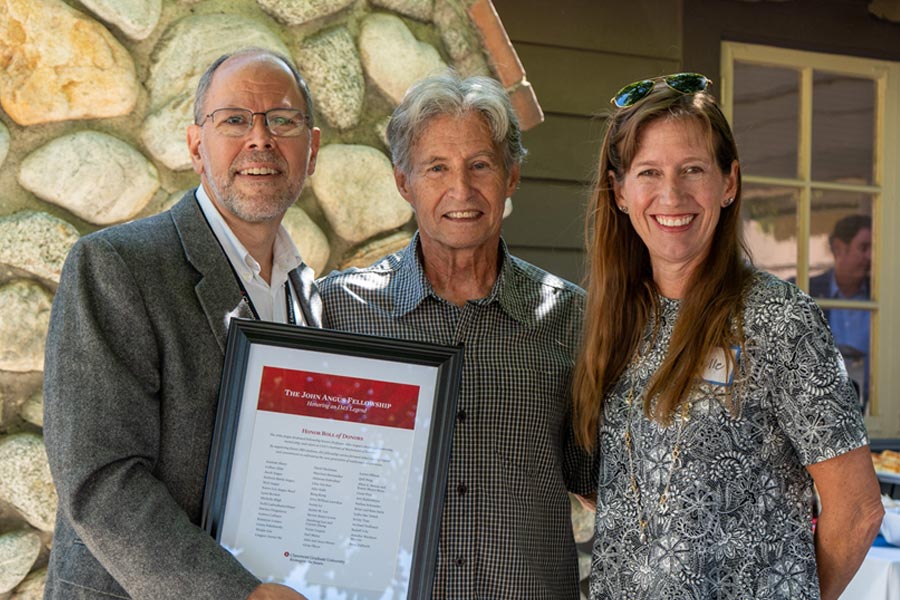
The fellowship was announced late last month during a fall celebration held at the IMS House and attended by students, faculty, supporters and many of the donors who helped make it possible. Angus was presented with a framed honor roll bearing the names of everyone—all familiar to him—who contributed to the endowed fellowship’s creation.
He and his family were deeply moved.
“This is just overwhelming to me,” Angus said. “I never dreamed anything like this would happen for me. I’d like to shake each one of the donors’ hands and thank them for not just honoring me but helping our students, too.”
Fellowships Changing Lives
The fellowship endowment now totals more than $250,000, and it is already providing financial assistance to current students. Its inaugural recipients are doctoral mathematics students Maxwell Kooiker and Yama Walizada, who were both on hand to express their gratitude to Angus and the IMS community.
“I worked so hard in my first year of my doctoral work, and I’m so happy to have that hard work acknowledged with this help,” said Kooiker, a second-year Mathematics PhD student. “I want to thank everyone, including John and Kathi Angus, IMS, and all the donors for helping me so that I can continue my work.”
For Walizada, the fellowship dramatically changed the trajectory of his plans.
“This was the deciding factor in my being able to come to CGU this fall,” said Walizada, who is studying statistics. “I’m in a transition with my funding, and receiving this fellowship meant I could start this fall and not postpone and wait a year to pursue my dreams of being a statistician.”
Organizers hope additional gifts will grow the endowment and allow the fellowship to support even more students in the future, helping make a CGU mathematics education accessible regardless of a student’s socioeconomic circumstances.
For Allon Percus, IMS director and a longtime colleague of Angus who spearheaded the fundraising effort, the fellowship also reflects one of the things that makes the student experience at CGU distinctive: the opportunity to build deep and lasting relationships with faculty members.
That connection, Percus said, was evident in the response to the fellowship.
“The outpouring of support and affection for John was just overwhelming,” Percus told attendees, noting that the endowment goal was reached and exceeded in under a year. “One of the goals of this event today is to thank the donors who are all friends and colleagues of ours for making their transformational contributions to our IMS community.”
The Angus Fellowship joins other financial awards that support mathematics students at CGU, including the Engelberg Fellowships in the Mathematical Sciences, which honor the memory of Ora Engelberg Percus, a trailblazing mathematician and professor.
Grace Akinwande, a current Engelberg Fellow, described the difference such support can make in a graduate student’s life.
“Over the past three years I’ve grown not just as a student but as a researcher, and my fellowship has given me the opportunity to do this without the burden of financial uncertainty,” said Akinwande. “I’m grateful to this fellowship for giving me the freedom and the peace of mind to pursue these goals.”
35 Years of Making Connections
Other students at the celebration offered their own examples of the impact Angus has had on their academic careers.
Victor Luquin, a doctoral student in a program partnered by CGU and Cal State Long Beach, decided to pursue his PhD after working for eight years with the U.S. Department of Defense. But because of his funding timeline and restrictions on research data related to his government work, he found that larger institutions were unwilling to work with him.
Then he connected with Angus and IMS.
“I was honestly at my last straw and was giving up on the idea of doing my research at any institution when I met Dr. Angus,” Luquin said. “But he was receptive and flexible, and he said, ‘That’s not a problem, we can do that.’ That changed everything for me.”
That flexibility, along with broad exposure to the field, are among the qualities that make IMS distinctive and are critical to the experience of mathematics students, said Earl Maize ’81, an Angus Fellowship supporter who attended the celebration.
Maize went on to a distinguished career at JPL, where he played a key role in the success of the Cassini mission to Saturn, as its program manager. For him, the value of a mathematics department can ultimately be measured by one question: Is it helping students advance their careers?
“A fellowship is the best way to help a department because it helps students. It just changes the game for them,” said Maize, who worked with Angus in the early 2000s after Angus invited him to join the IMS Board of Visitors. “Getting support for this fellowship wasn’t hard because his leadership inspires others. The way that he’s built the department, he’s been just an amazing force.”
When Every Gift Counts
The Angus Fellowship demonstrates that the impact of philanthropy is not always measured by the size of an individual gift. Sometimes, it comes from bringing many gifts together around a shared purpose.
Assistant Vice President of Advancement Michael Spicer said donors may think primarily about their contributions as individual gifts without realizing the difference those gifts can make when combined—particularly when they come together to honor a professor who has had a profound impact on students’ graduate experiences.
“Gifts of every size have a great effect this way,” said Spicer, who is also exploring ways to bring together gifts to honor faculty members in other CGU schools and programs, including education and psychology. The goal, he said, is to create opportunities that can have a lasting, positive effect on future students.
That means that all gifts are welcome, with each donor giving what they can to create something much larger and more impactful than any single contribution might provide on its own.
For Angus, it is a fitting tribute to a career spent helping students understand the power of mathematics—and to the relationships that can make that education matter long after a student leaves the classroom.