A Legacy Unpacked: Inside the Effort to Catalog Connie Zehr’s Art
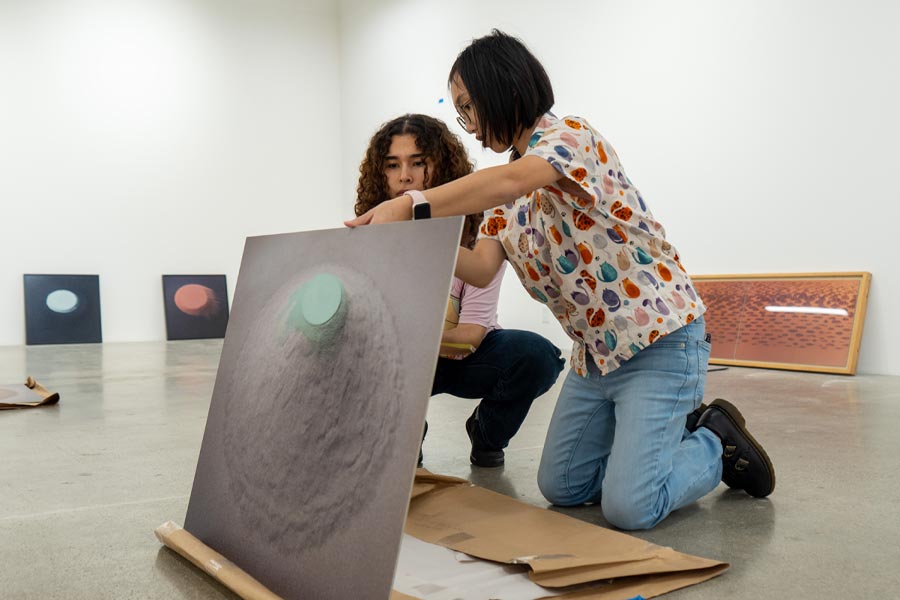
A year after her son drove her collection across the country, students and staff have cataloged more than 550 works by the Light and Space artist and longtime CGU professor. The exhibition is now open.
Most artists create with the hope that their work will outlast them, but Connie Zehr was deliberate in ensuring that hers would not.
Zehr was a central figure in the Los Angeles Light and Space Movement of the 1960s and ’70s. She crafted her installations from sand, light, feathers, and household items. Rather than making them in a studio, she built her mounded sand pieces, the work she was best known for, directly in the museums and galleries where they were shown. They were ephemeral by design.
Zehr’s work has been shown across the country and abroad, including at the Museum of Contemporary Art in Chicago, the Wadsworth Atheneum in Hartford, Connecticut, and in Milan and Taipei. After retiring from Claremont Graduate University in 2009, she moved to Horseheads, New York, where she continued making art in her studio.
Following her passing in April 2025, Zehr’s son, Eric Elder, personally packaged and drove her collection over 2,600 miles from New York to Claremont to fulfill her request that it go to the CGU Art Department, where she had taught for 27 years.
Though none of her sand pieces survive in the collection, what does remain are hundreds of photographs printed on aluminum, Mylar, and paper that capture her installations and decades of experiments with light, space, and transparency. Those images serve as a bridge between work designed to disappear, and a legacy meant to endure.
The selection, titled AS IS, IS NOT: Through the Eyes of Connie Zehr, was on display at the Peggy Phelps and East galleries of Stauffer Hall.
From Inventory to Archive
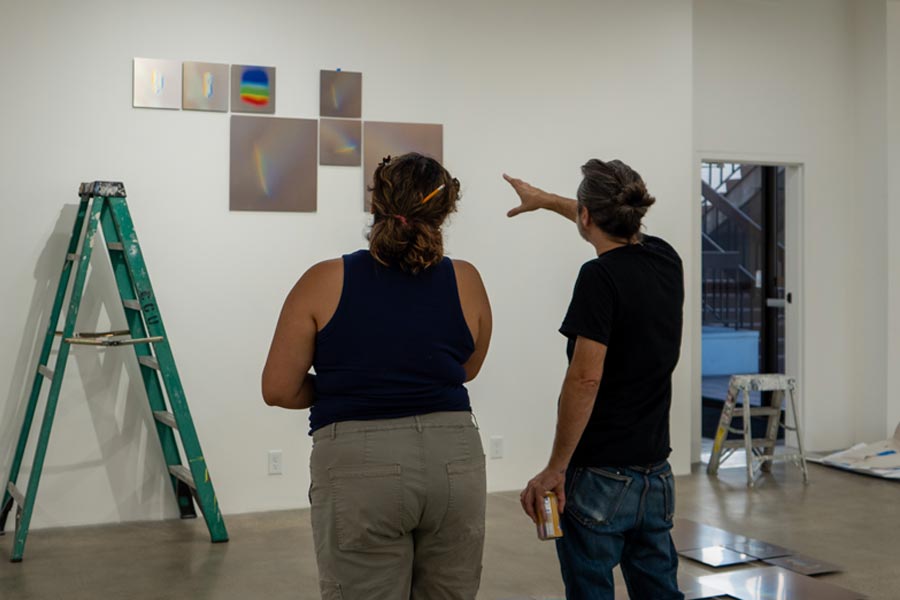
Kim Alexander, gallery, studio and shop manager for the art and music departments, has overseen the collection since it arrived last summer.
“The first step was to complete a general inventory of everything donated so we could get an idea of the project’s scope,” Alexander says.
Much of the early inventorying of the 550-plus objects was done by art collection intern Diana Corea, who is pursuing a master’s degree in art history and Archival Studies.
In spring 2026, Alexander worked with Religion Professor Tammi Schneider and Art Department Chair David Pagel to secure support from CGU’s Thornton F. Bradshaw Programs and Endowment Fund, which backs collaborative projects in the humanities.
The funding allowed the team to fully archive and document the works and bring them into CGU’s physical art collection and digital management system. It drew students from Museum and Archival Studies, Religion, Cultural Studies, and Art, turning an inventory into what Alexander calls a collaborative and interdisciplinary effort.
For Nancy Yonglin Guan, a second-year master’s student in History and Archival Studies, the first challenge was figuring out where to start.
“When I first began archiving the artwork, there was not yet an established archival guideline or standardized style for organizing the collection,” Guan says.
She decided to build one, creating a file and labeling system for every piece in the digital archive. Each work was sorted by category, photographed, and uploaded, then wrapped, labeled with its name and series, and returned to its box.
By the time Lijun Chen, a second-year PhD student in Cultural Studies, joined the project in late August, Corea and Guan had already done much of the cataloging. Chen settled into the same rhythm of unpacking, checking condition, measuring, photographing, cataloging, and repacking, a process she found “full of little surprises.”
The best one came near the end of cataloging. Chen reached for the final item in the storage box, which turned out to be the missing piece from one of the series in the exhibition.
“The feeling of satisfaction and joy was like cracking a code and finally finding the very last digit,” she says.
What the Sand Left Behind
The collection holds none of the sand installations Zehr is best known for. They were never created with the intention of preservation, and Alexander said no documents, instructions, or diagrams for the installations came with the collection. Instead, it centers on her photography and her experiments in that medium. Digital prints on aluminum, framed photographs, posters, and digital prints on Mylar and paper.
“What remains of her work with sand and installation art are her highly intentional and poetic photographs of those pieces,” Alexander says.
For Chen, who had read about Zehr’s work online before joining the project, impermanence was part of the draw. “Installations are hard to collect,” she noted, “and some can be shown only once. In a way, what she was pursuing was a kind of temporary beauty.”
Up Close with the Art
After months spent with the work, the students developed a close connection with a few different series.
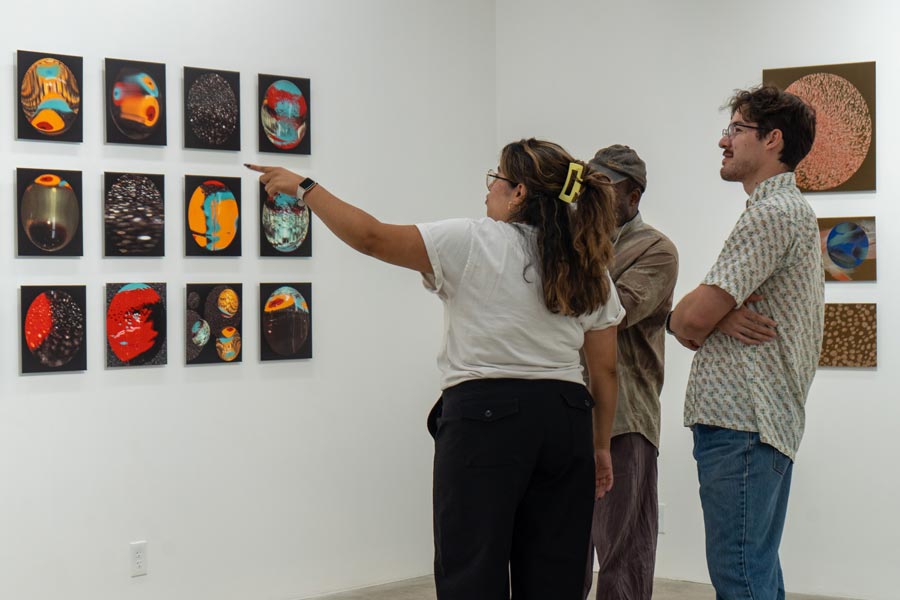
Guan’s is the As Is/Is Not series, four works of colored circles on black backgrounds. The series also gives the exhibition its name.
“Whenever I look at any of the four pieces in the series, I feel as though I am being drawn into a wonderful world,” she says.
Chen also references that series as one of her favorites, along with The Place Between, close-up prints of Zehr’s installations in sand and glass, as well as the Atoll series. Even without the installations themselves, Chen says, the collection still lets viewers “sense her exploration of materials, light, and space, as well as the ideas and process behind her work.”
Among the collection’s many surprises, Alexander said, were a few photographs in which Zehr detailed the motions and positions of her own hands. “The collection includes many surprises,” Alexander says. “There are a few photos where she detailed motions and positions of her hands which were quite unexpected and are particularly moving.”
Putting it on the Walls
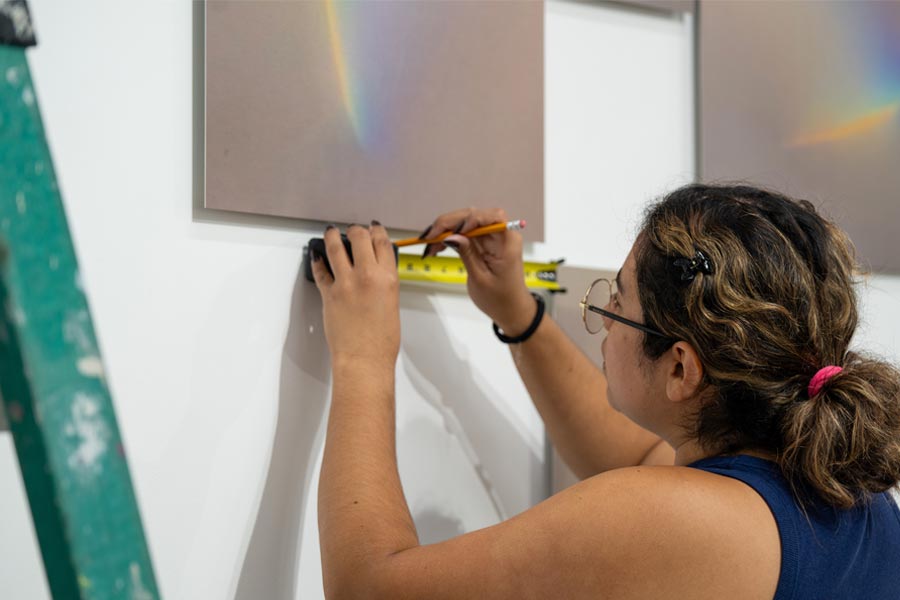
With the archiving complete, the team turned to creating an exhibition that would reflect the breadth of Zehr’s work. Alexander describes it as a retrospective in photography and digital processes, and as a physical record of the past year’s research. The goal is to create a range that spans multiple decades and reflects what Alexander notes as “the complexity and subtlety of Connie’s approach to photography.”
“We were sure to include some of her large clusters and arrangements of multiple images, which was a hallmark of her work.”
Zehr’s son Eric Elder wasn’t able to attend the gallery’s opening, but he plans to follow along virtually. He still thinks about his mother’s work and the experience of bringing it to CGU.
“I didn’t fully appreciate it at the time, but looking back on it now, I realize how therapeutic the whole experience was for me. [The drive] gives you a lot of time to think, which was so healing at the time.”
Bringing the collection to the campus that was her professional home for so many years, he says, “felt like coming full circle.”
“My mom would have been thrilled, both that her collection was received by CGU and that the university has chosen to mount an exhibit in her honor,” Elder says. “She was creating her artwork all the way until the final days of her life, and she would be proud to know that others will be able to appreciate her work even after she is gone.”
Hands-on Experience in Archiving
For Alexander, the biggest reward was the experience students got in collection archiving, collection management, and exhibition planning.
“The students really stepped up as leaders and responsible researchers, and I’m very proud of them,” he says. “Without their diligence and commitment, this work could have easily taken many years or may have never happened.”
Guan came in with experience archiving documents, not artwork, and the project widened her sense of the field. Photographing, describing, wrapping, and storing physical pieces taught her that there is more than one style of archival work, and that archivists have to adapt to the collection in front of them. She now feels more prepared to pursue archival jobs with art collections as well as document archives.
Chen, whose research focuses on cultural memory, sees the project in larger terms.
“We are not simply archiving and managing Zehr’s works. We are building a cultural resource that can be accessed and explored.”
Much More to Exhibit
For Alexander, the exhibition is only the beginning.
“This represents just a fraction of what was donated to us, so there’s much more to exhibit,” he says.
He sees room for student research into how Zehr’s practice intersects with minimalism, feminism, earth art, and Light and Space. And because the Smithsonian’s Archives of American Art holds her sketchbooks, writings, installation plans, and notebooks, he hopes there’s potential to collaborate with that institution on future exhibitions and maybe even re-create some of her installations.
Though Zehr’s sand has been returned to its home in the Nevada desert, one day, her mounds may rise again on a gallery floor. Until then, more
than 550 pieces live in CGU’s art collection and digital archive, ready for the next generation of art students to be drawn into her world.