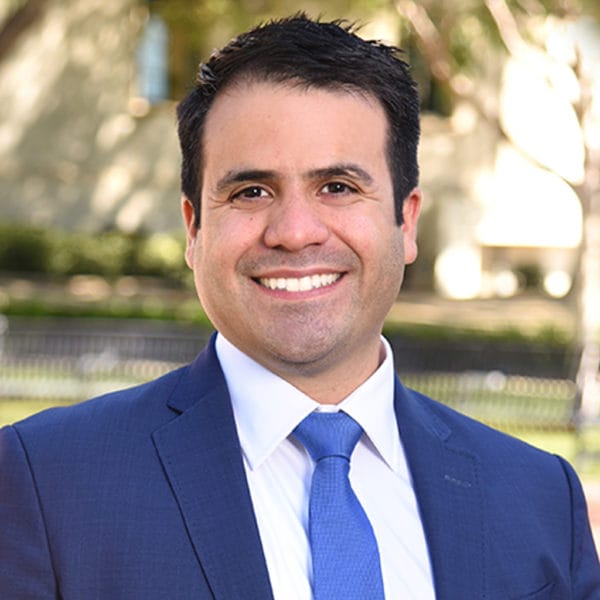
Carlos Algara is an assistant professor of political science at Claremont Graduate University, joining the department in July 2021. He is also a faculty affiliate at the Center for Effective Lawmaking, a joint research group directed by the University of Virginia and Vanderbilt University. Prior to coming to CGU, Algara was a 2019-2020 American Political Science Association Congressional Fellow working on legislative procedural and democratic accessibility policy areas within the United States Senate.
Algara received his PhD from the University of California, Davis in June 2019. His research agenda focuses on the nature of ideological representation in the United States, political parties, electoral accountability, legislative behavior, and what factors inform the policy preferences of the mass public. The core of this work centers on understanding mass elite-citizen linkages by assessing what drives the political preferences of citizens, and how these preferences inform the representation provided to them by political elites, such as legislators, electoral candidates, parties, and collective institutions.
Much of his research takes the form of active collaborations with graduate student colleagues, with some of this research being published or forthcoming in Political Behavior, PLoS One, Electoral Studies, American Politics Research, Congress & the Presidency, Politics & Gender, and other peer-reviewed outlets. His research has been supported by the Dirksen Congressional Research Center and the Center for Effective Lawmaking, while also being covered in popular media outlets such as The New York Times, National Public Radio, Texas Tribune, Sacramento Bee, and the Niskanen Center’s The Science of Politics podcast. Prior to joining CGU, he was a faculty member at the University of Texas at El Paso.
Co-authored with Sara Kazemian and Sam Fuller. “The Role of Race and Scientific Trust on Support for COVID-19 Social Distancing Measures in the United States.” PLoS One, (2021): 1-23.
“Congressional Approval & Responsible Party Government: The Role of Partisanship & Ideology in Citizen Assessments of the Contemporary U.S. Congress.” Political Behavior, (2021): 1-41.
Co-authored with Samuel Fuller and Christopher D. Hare. “The Conditional Effects of Scientific Knowledge & Gender on Support for COVID-19 Government Containment Policies in a Partisan America.” Politics & Gender, (2020): 1-10.
Co-authored with Isaac Hale. “The Distortionary Effects of Racial Animus on Proximity Voting in the 2016 Elections.” Electoral Studies 58, no. 1 (2019): 58-69.
“The Conditioning Role of Polarization in U.S. Senate Election Outcomes: A Direct-Election Era & Voter-Level Analysis.” Electoral Studies 59, no. 1 (2019): 1-16.
Co-authored with Joseph Zamadics. “The Member Level Determinants & Consequences of Party Legislative Obstruction in the U.S. Senate.” American Politics Research 47, no. 4 (2019): 768-802.
American Political Behavior
American Politics Core Seminar
Elite Representation in the United States