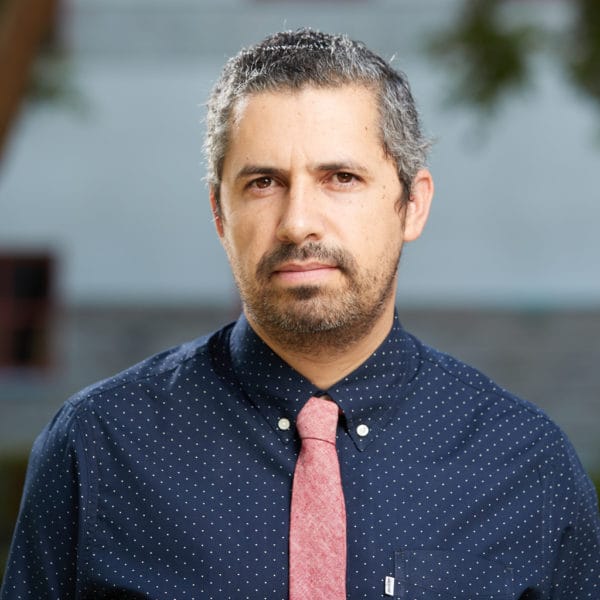
Romeo Guzmán is an assistant professor in history at Claremont Graduate University. His research seeks to bridge Chicanx historiography and scholarship on modern Mexico by offering transnational histories of Mexican migrants and Mexican-Americans. His research interests include citizenship, migration, sport, public history, and digital humanities.
Guzmán’s public history work strives to transform how underrepresented communities enter the historical record and to redefine the role of both historians and archives in society. Before arriving at CGU, Guzmán was an assistant professor at California State University, Fresno (2016 to 2020), where he founded and directed The Valley Public History Initiative: Preserving our Stories. In his capacity as the director, he worked with students, faculty, and community members to launch “Straight Outta Fresno: From Popping to B-boys and B-girls” and “The Other Football: Tracing the Game’s Roots and Routes in the San Joaquin Valley.”
Since 2012 he has co-directed, with Carribean Fragoza, the South El Monte Arts Posse (SEMAP). Placing marginalized communities at the center of knowledge production and art-making, SEMAP has built archives, led walking tours, painted murals, made documentaries and short films, organized teaching-ins, and published East of East: The Making of Greater El Monte (Rutgers, 2020), which is a required text in the El Monte school district’s Ethnic Studies courses. From 2023-24, SEMAP founded and ran CASA Zamora (Culture, Archive, Solidarity, Action), a cultural center at Zamora Park, in El Monte. At the intersection of social arts practice, public history, and radical pedagogy, CASA Zamora housed an archive and lending library, offered art classes to children, youth and adults, hosted cultural events and exhibits, loaned out soccer balls and nets, and provided a variety of residencies.
From 2019-22, Guzmán co-edited Boom California, an open-access and public facing online journal of UC Press. He is currently an editor-at-large at Zocalo Public Square.
Guzmán’s book in progress, Orphans of the Nation: Mexican-Americans, Transnational Citizenship, and Belonging, the 1920s to 1940s, examines how migrant families used formal politics and daily and cultural practices to engage U.S. and Mexican citizenship.
A resident of the San Gabriel Valley, he is proud graduate of Garey High School and Mount San Antonio Community College.
“‘I Want to Return to My Country: Ethnic Mexicans Request the Right to Return during the Great Depression,” Journal of American Ethnic History, Volume 44, Issue 2, 2025
“Paper Trails: Repatriates, Mexican Consuls, and Transnational Mobility during the Great Depression,” Journal of American History, Volume 109, Issue 2, 2022
“’Imaginemos Cosas Chingonas’: Building The Other Football Public History Project.” Teaching Public History, edited by Julia Brock and Evan Faulkenbury, (UNC Press, 2023)
“Field of Dreams: Migrant Futboleros in Greater Mexico.” Boom California, (2018).
“The transnational life and letters of the Venegas family, 1920s to 1950s.” In Migrant Letters: Emotional Language, Mobile Identities, and Writing Practices in Historical Perspectives, edited by M.J. Borges and S. Cancian. Routledge, 2017. (Originally published in The History of the Family)
“Rebel Archive: A History of La Casa de El Hijo Del Ahuizote.” In Regeneración: Three Generations of Revolutionary Ideology, edited by P. Tompkins Rivas. Mexico City: Vincent Price Art Museum and La Case de El Hijo del Ahuizote, 2018.
Romeo Guzman, C. Fragoza, A. Cummings, and R. Reft, edt. East of East: The Making of Greater El Monte. Rutgers, 2020.
Romeo Guzman, C. Fragoza, and S. Joudat, edt. Writing the Golden State: The New Literary Terrain of California (Angel City Press, Fall 2024)
Creative Projects
A.R.A.C.F. Mānoa: A Pacific Journal of International Writing (University of Hawai’i Press, Fall 2025)
Pocho Blues (Sybil Press, 2022)
Romeo Guzmán, C. Fragoza and D. Flores Magón, edt. Burn the Wagon: Writings from Greater El Monte. Mexico City: La Casa de El Hijo del Ahuizote and South El Monte Arts Posse, 2017.
Approaches to Public History: Centering Marginalized Communities